 Speed Comp
Music that keeps up with the boat
The volume that sounds right tied up at the dock is gone the moment you get on plane. Speed Comp reads your GPS speed and raises your Bluetooth speaker as you open up, then brings it back down when you throttle back for the no-wake zone.
Bowriders, pontoons, centre consoles, tenders, sailboats under power — anything with a phone and a speaker aboard.
Perfect at the dock, gone on plane
Wind across the bow and the engine behind you climb with speed. The speaker does not.
Wind wins on plane
At cruise the wind and the outboard flatten whatever the speaker was doing. Turning it up by hand means letting go of the wheel or the throttle.
Too loud at idle
Cranked for the run across the lake, the same volume is deafening when you drop off plane to talk, tie up or drift. Speed Comp settles back to your baseline on its own.
Wet hands, sealed phone
A phone in a dry bag or the glovebox is not a phone you want to be poking at. Set it before you cast off and leave it there.
Three moving parts
Set a speed range, start compensation, and go. Everything after that is automatic.
Pick your range
Choose the speed where compensation should start and the speed where it should top out — in MPH or KPH. Below your minimum, the app leaves your volume alone entirely. On a boat, try starting at about 8 mph — the top of most no-wake zones — and topping out at your usual cruise: 30–40 mph for a bowrider, lower for a pontoon.
Set your baseline
Tap start at a volume that sounds right while stopped. That level becomes the floor. Speed Comp only ever adds to it — it will never turn your music down below where you set it.
Ride
GPS speed drives the volume curve continuously in the background, screen off. A Live Activity on iPhone, or an ongoing notification on Android, shows it running — with a stop button always one tap away.
Set up for the water
Tune it at the dock
Run the built-in simulation before you untie. It ramps a fake speed from zero to your maximum through the same path as real GPS, so what you hear at the slip is what you get on plane.
The boat's own stereo
If the stereo plays from your phone over Bluetooth, Speed Comp moves the level your phone sends it. A portable speaker in the cupholder works exactly the same way.
One profile per boat
The pontoon and the bowrider want different ranges, and the tender wants a third. Plus keeps three saved profiles; Pro keeps as many as you like.
What it looks like
The same app on iPhone and Android: a speed, a volume, and how much the app has added.
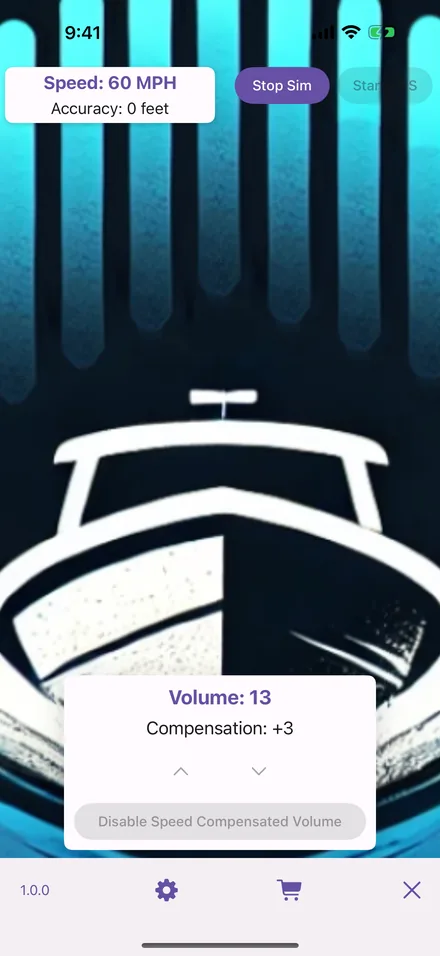
Running
Speed, volume and the amount added, with a stop button.
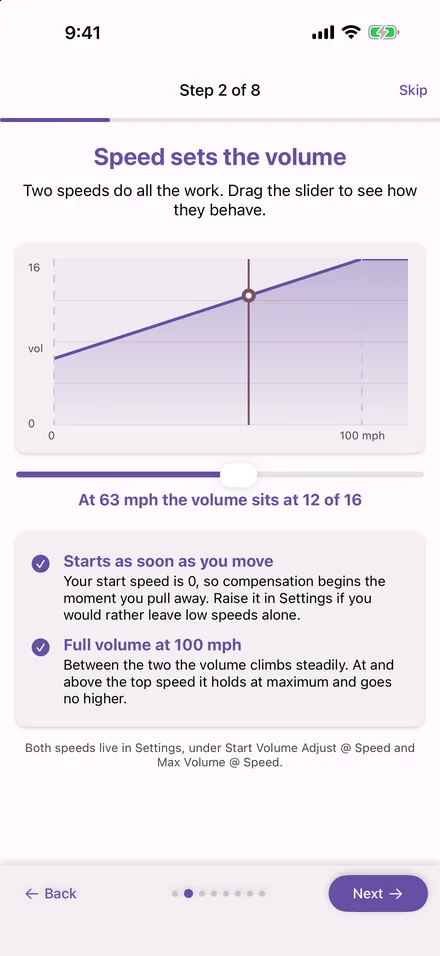
The curve
Two speeds do all the work; between them the volume climbs steadily.
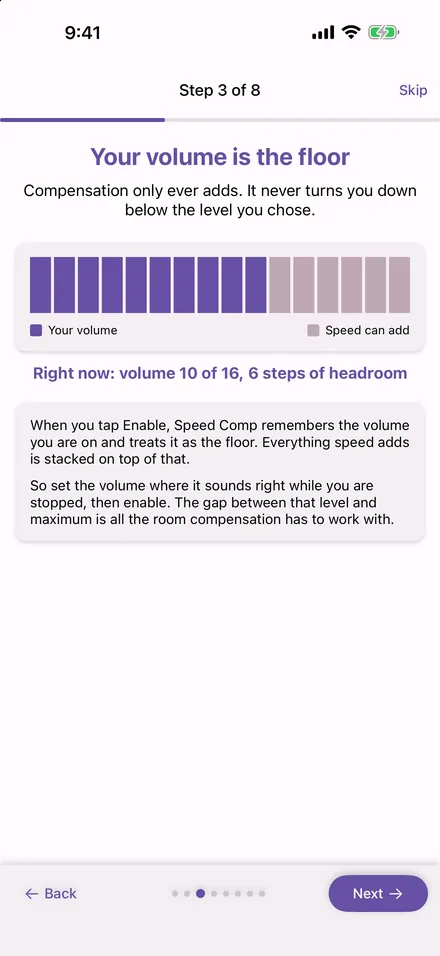
The floor
Your starting volume is the floor. The app only ever adds to it.
Free to use, for as long as you like
Speed compensation is not a trial and does not expire. The only limit without a subscription is that each session runs for up to two hours, then stops — start it again and you get another two. A subscription lifts that limit and adds the extras below.
Free
No account, no ads, no expiry date.
- Full speed-to-volume compensation
- Two hours per session, restart as often as you like
- Speed simulation for tuning while stopped
Plus
Everything in Free, without the session clock.
- No session time limit
- Up to three saved profiles
Pro
Everything in Plus, plus the audio extras.
- Unlimited saved profiles
- Smooth gain between volume steps
- Now-playing display with transport controls (Apple Music on iPhone)
Where your data goes
Speed Comp needs precise location because that is the only way a phone knows how fast you are moving. It does not follow that the app needs to keep it, and it does not.
- Your location never leaves your device. Speed is read, turned into a volume, and discarded; no location history is kept, not even on the phone.
- No ads, no advertising ID, no tracking, no account.
- Anonymous usage analytics only — which screens are opened, whether a session or a purchase went through. The policy lists every event.
Questions from boaters
Does it work with the boat's built-in Bluetooth stereo?
If your phone is what plays the music, yes. Speed Comp moves the phone's media volume — the level your phone sends over Bluetooth — so any speaker, headset or built-in audio system that is playing from your phone follows along. A device with its own volume knob applies that on top: leave it where you like it and let the phone's level do the moving. What the app cannot reach is a stereo playing its own source, such as FM radio or a USB stick.
Does GPS work out on the water?
Very well — GPS wants a clear view of the sky, and a boat has one. It measures speed over ground, the same figure a chartplotter shows.
Can I set the range in knots?
Not yet: the app offers MPH and KPH. As a rule of thumb, 20 knots is about 23 mph or 37 km/h.
Will it keep running with the phone in a dry bag?
Yes. On iPhone the app keeps receiving location in the background and shows a Live Activity on the Lock Screen with a Stop button; on Android it runs as a foreground service with an ongoing notification, also with Stop. Screen off, phone sealed away — it keeps working.
Will it ever turn my music down below where I set it?
No. The volume you have when you start compensation is the floor. Speed Comp only ever adds to it, and comes back to exactly that level when you stop moving.
Set it once, before you cast off
Free on iPhone and Android. Pick a range at the dock and stop reaching for the volume on plane.